 Chichen Itza Entry Tickets
Visiting Chichen Itza Without a Tour: Tickets, Route and the DIY Day Plan
Visiting Chichén Itzá without a tour is remarkably easy, and the site is built for it: the site is built for independent entry, one ticket covers everything inside the fence, the paths are signed, and a licensed guide can be hired at the gate if you change your mind. This page is the full DIY plan - the honest cost sheet, a walking route that beats the tour-bus flow, the climbing rule, and what a guide adds for the $800-1,800 MXN they charge per group.

The Temple of the Warriors' column forest - best read with a guidebook in hand and no timetable behind you. Photo: Wikimedia Commons (CC BY-SA 4.0).
Quick answer Yes, you can go alone: the ticket, the route order and the guide question answered
No tour is required - a bare entry ticket ($79 online, $697 MXN at the gate) covers the whole zone, and transport is your only real prerequisite: an ADO bus, a colectivo from Valladolid or a rental car (see how to get there). Enter at 8:00, walk El Castillo first while it is quiet, then the Ball Court, Temple of the Warriors and Sacred Cenote in a 2-3 hour loop. Decide on a guide at the gate: MXN $800-1,800 per group, shareable with strangers - or go guideless with 30 minutes of reading. Climbing El Castillo has been prohibited since 2008.
Key takeaways
- Ticket only: Tiqets $79 or gate $697 MXN - the whole zone, no guide required.
- Beat the buses: enter at 8:00, Castillo first; tour groups land 10:30-13:00.
- Guide at the gate: MXN $800-1,800 per group - split it with another family if you want one.
The DIY Cost Sheet
An independent day's arithmetic, per person, assumes two people sharing a rental car or riding the bus - the numbers that decide whether the DIY day beats the $57-120 tours.
| Line item | Cost | Note |
|---|---|---|
| Entry ticket (online) | $79 US | Tiqets or GYG, both taxes in |
| Entry ticket (gate) | $697 MXN (about $38-44) | Queue included in the price |
| ADO bus from Cancún, return | MXN $440-960 | About $220-480 each way, 2.5 hours |
| Colectivo from Valladolid, return | MXN $70-240 | 45 min-1 h each way, frequent |
| Rental car, one day (shared by 2) | MXN $500-900 per person | Plus parking, about $120 MXN |
| Gate guide (optional) | MXN $800-1,800 per group | Split with strangers to halve it |
| Cenote swim after (optional) | MXN $150-300 | Ik Kil or similar near Pisté |
Reading the sheet
For a couple driving themselves, the DIY day lands around $60-90 US per person with a ticket, car and cenote - squarely inside tour pricing, but with your own timetable: stay until the 17:00 close or leave at noon, stop at a cenote the buses skip, and eat in Valladolid instead of at the entrance restaurants. Solo travellers do better on the bus than a rental; groups of three or more do better DIY than on any tour.
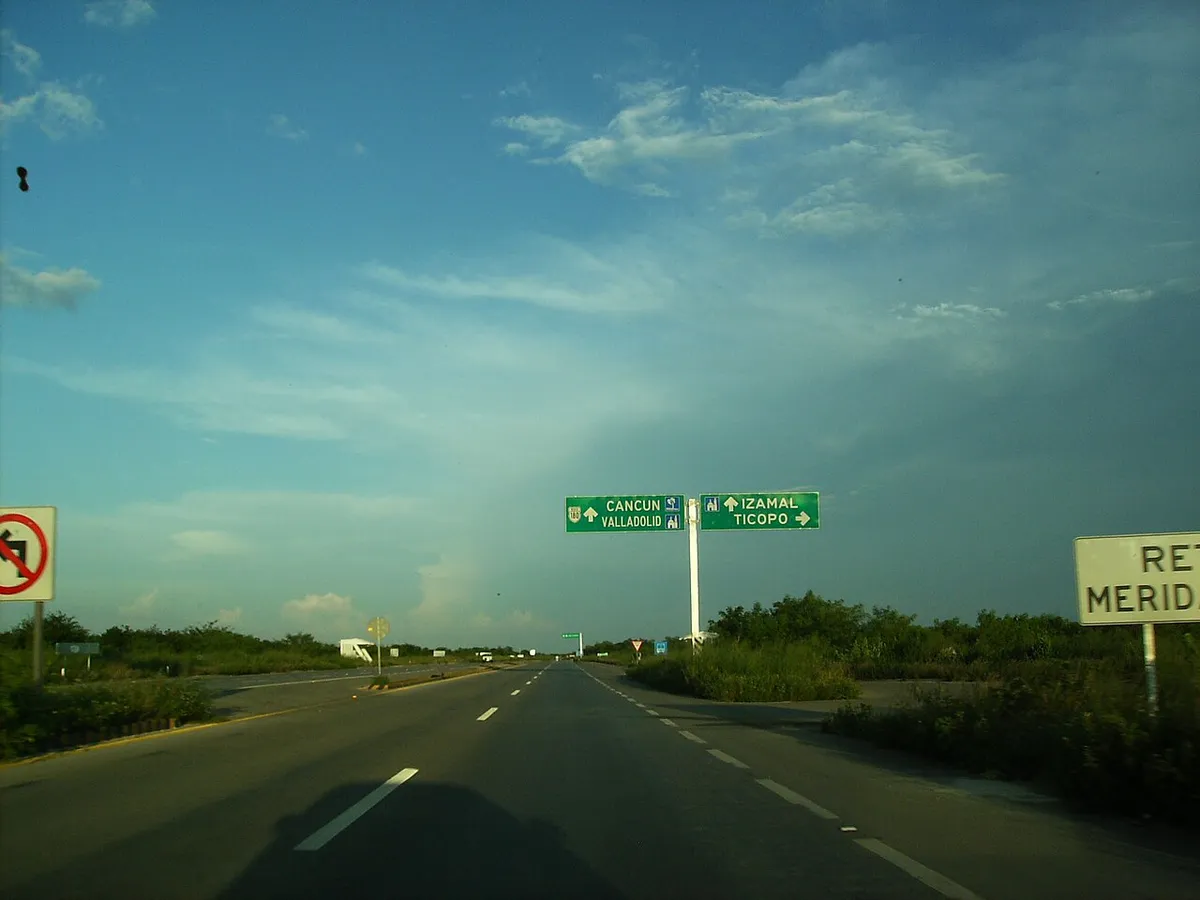
Highway 180 toward Cancún - the DIY visitor's road. Photo: Wikimedia Commons (public domain).
The Walking Route: Three Hours That Beat the Buses
The site is a series of platforms on a lawn; the trick is sequence. Tour groups enter, stand in front of El Castillo for 30 minutes, then orbit. You will do the opposite.
| Time | Stop | Why this order |
|---|---|---|
| 0:00-0:40 | El Castillo (Temple of Kukulcán) | Empty plaza at 8:00 - take the photos before the crowd |
| 0:40-1:10 | Great Ball Court | Next door; the largest court in Mesoamerica |
| 1:10-1:40 | Temple of the Warriors + Group of a Thousand Columns | Shade under the columns as the sun climbs |
| 1:40-2:00 | Platform of the Skulls + platforms | Small carvings, few visitors |
| 2:00-2:30 | Sacred Cenote | The sinkhole loop, past the vendors' gauntlet |
| 2:30-3:00 | El Caracol + Osario (or exit) | Outlier group - quietest corner; exit when the buses are queueing |
The climbing rule, stated plainly
You cannot climb El Castillo, and have not been able to since 2008. Interiors across the zone are closed the same way: everything is viewed from ground level, ropes and signs enforced. What feels like a loss at first is also why the lawns stay walkable - the 2008 closure came after a visitor's death, and it applies to every pyramid at the site. If climbing is the point of the trip, Ek Balam still allows it on its main structure, 45 minutes north.
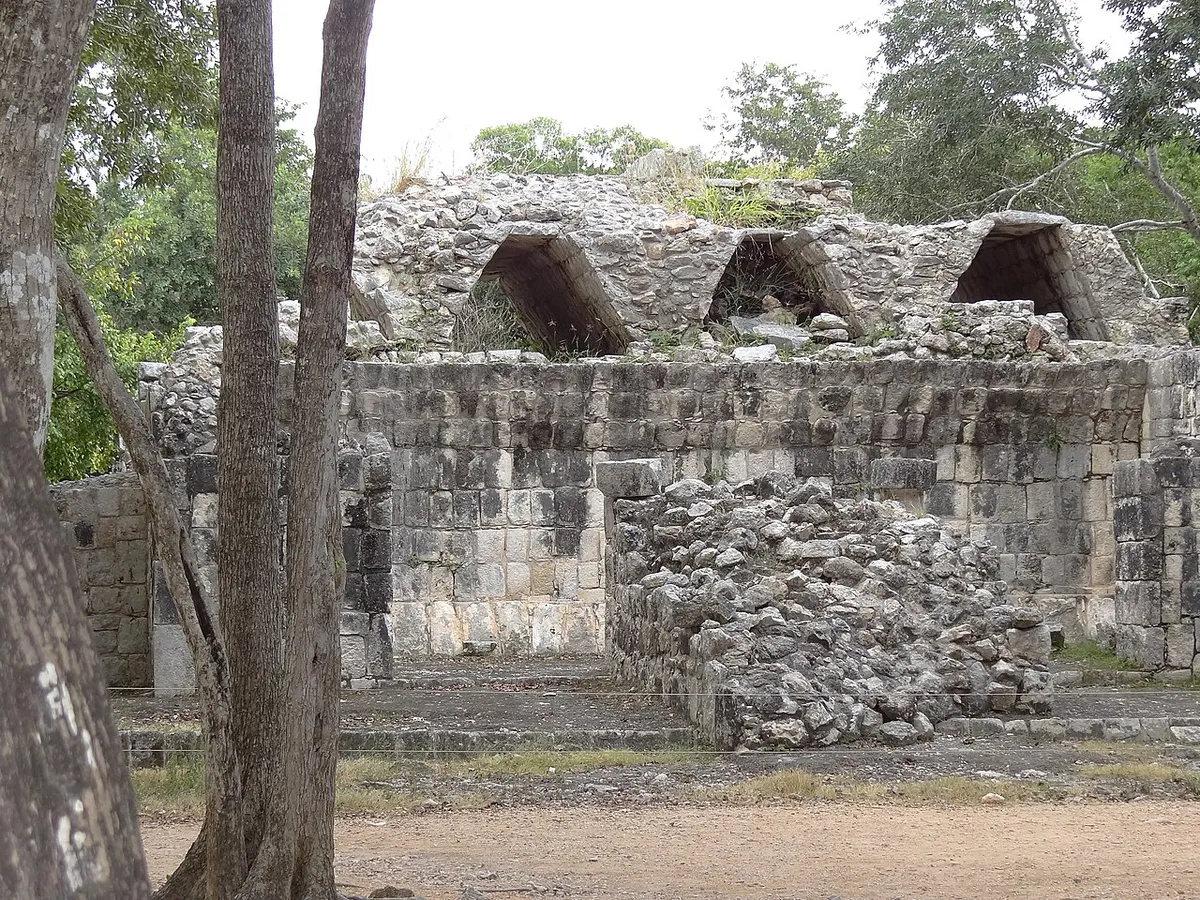
The Group of a Thousand Columns - mid-route shade and the quietest hour of the DIY morning. Photo: Wikimedia Commons (CC BY-SA 3.0).
Guideless, Audio, or a Gate Guide?
Three honest ways to get the history on a DIY day, ranked by cost and depth.
| Option | Cost | What you get | Who it suits |
|---|---|---|---|
| Guideless + reading | Free | 30 minutes of prep covers the main buildings | Independent travellers happy with context over detail |
| Audio/in-app guides | Free-$15 | Room-by-room narration at your own pace | Solo visitors who want the storytelling |
| Gate guide | MXN $800-1,800 per group | Certified, answers questions, corrects myths | Families and first-timers; share with strangers |
The vendors are inside the site
One surprise of a guideless visit: the craft vendors line the interior paths - a concession, not a scam, and prices soften the deeper you walk. A polite 'no gracias' ends every pitch. It is the single biggest difference from European sites and reads as chaos for the first ten minutes; the route above takes you through the thickest stretch (Sacred Cenote path) at the busiest hour, which is deliberate - by then the morning's rhythm is set.
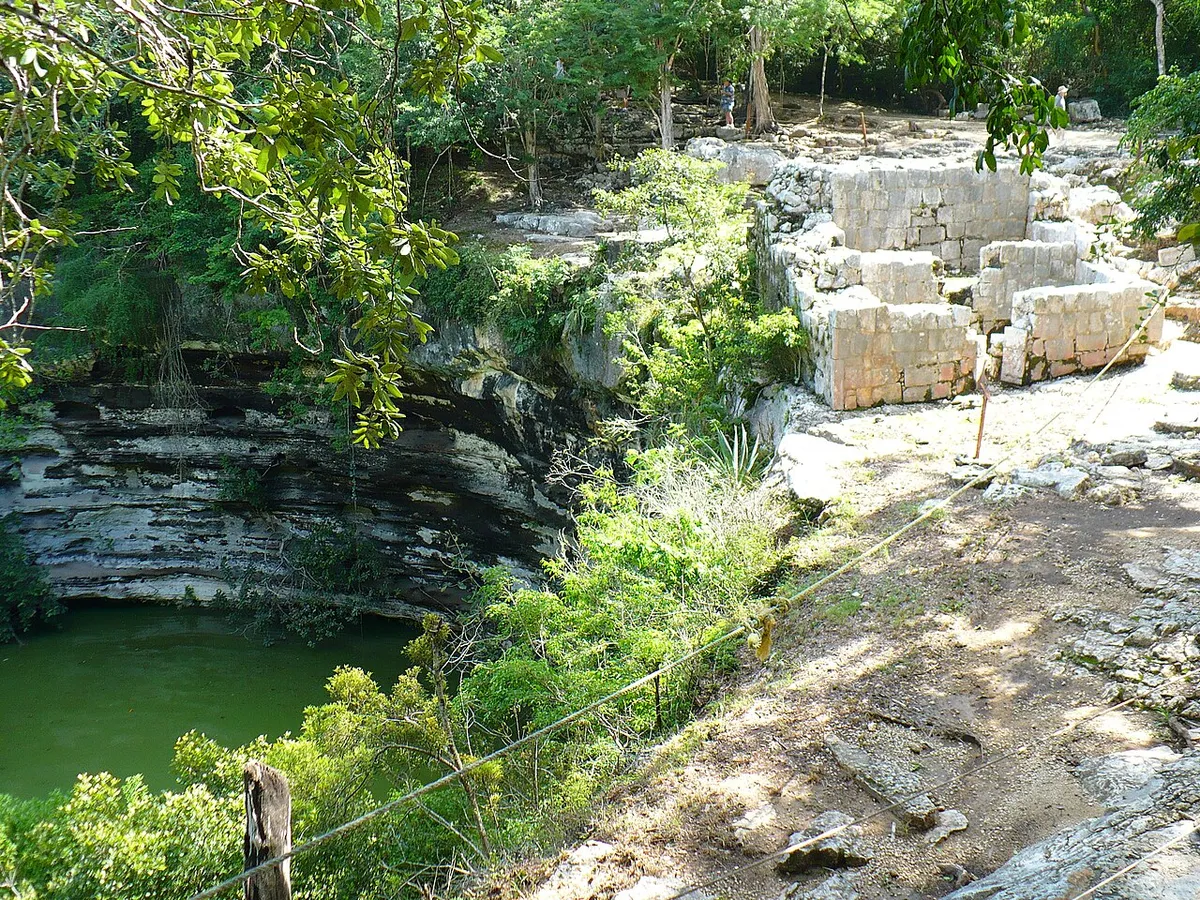
The Sacred Cenote from the viewing platform - swimming is not allowed; the water is where offerings went. Photo: Wikimedia Commons (public domain).
Site Rules That Shape an Independent Day
Small rules, big consequences for anyone carrying their own bag and water.
The short list
No food past the gate - sealed water is allowed and bags are checked. No drones, and professional cameras may attract a small fee. No swimming in the Sacred Cenote - it is a viewing platform; your swim happens at a commercial cenote outside (Ik Kil is 10 minutes away, Zaci in Valladolid). Last entry 16:00, site closes 17:00. And the vendors, again: inside the fence, everywhere along the central axis. None of this is on the ticket page of any listing - it is just what the DIY day needs to know.
One more, learned the hard way by solo visitors every week: the site has no lockers past the entrance, so whatever you carry is yours for the whole 2-3 hours - pack light, drink often, and leave the beach bag at the hotel.
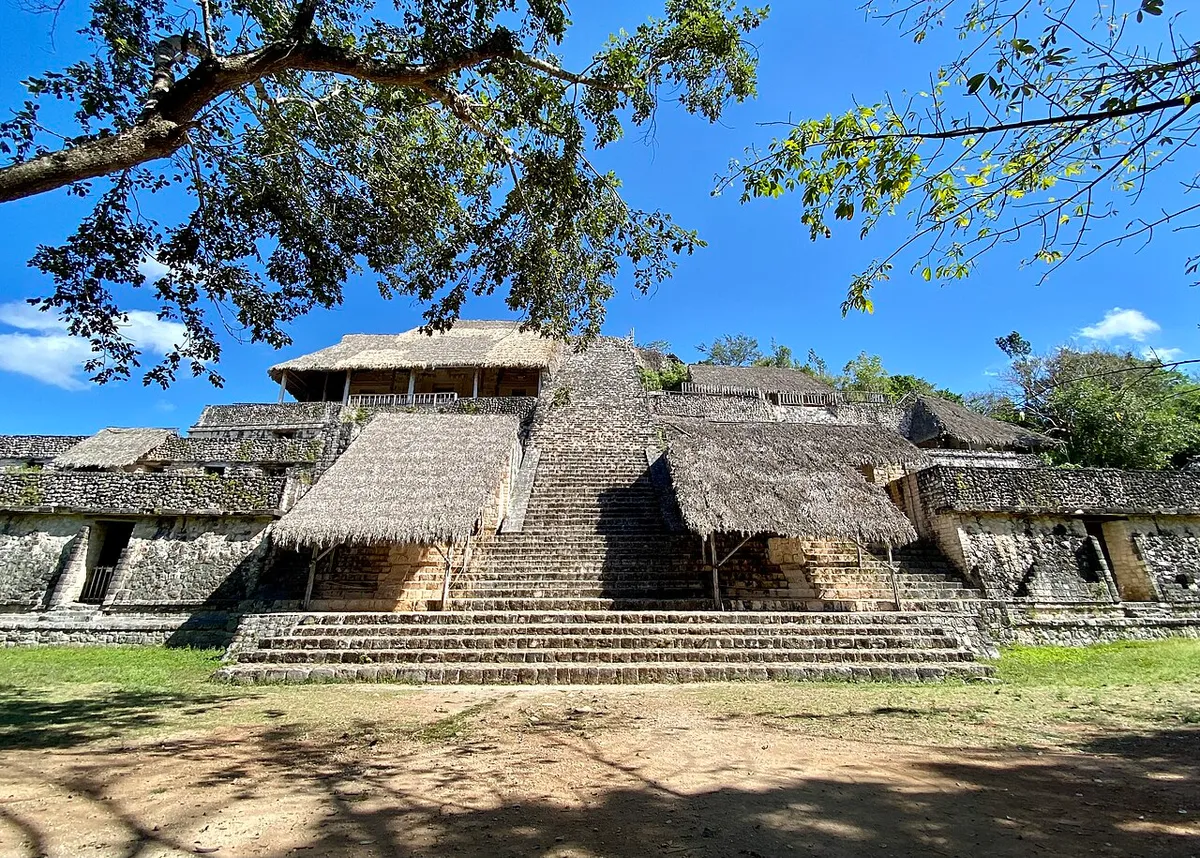
Ek Balam's Acropolis - where the climbing itch can still be scratched, 45 minutes north. Photo: Wikimedia Commons (CC BY 2.0).
Arriving Without a Car: the Pisté Walk
Most independent visitors arrive by bus, and the last leg is a flat 15-20 minute walk from the Pisté stop to the ticket gates - the colectivos ferrying the unwilling cost a few pesos for the same trip. The walk matters for one reason: timing. The ADO's useful morning departure lands mid-morning, exactly when you wanted to be standing in an empty plaza, so the bus itinerary needs an honest reframe: take the earliest service, accept a 10:00-ish entry, and use the route order to stay ahead of the crowds rather than inside them.
Full schedules and the car alternative sit on the how-to-get page.
What the bus version costs you and saves you
It costs the 8:00 hour - the visit's best light and emptiest lawn - and about $60-90 of rental-car freedom. It saves the tolls, the parking ($120 MXN), the insurance deposit and the return-drive drowsiness. For solo travellers the bus math usually wins; for pairs and families with any driver in it, the car usually does.
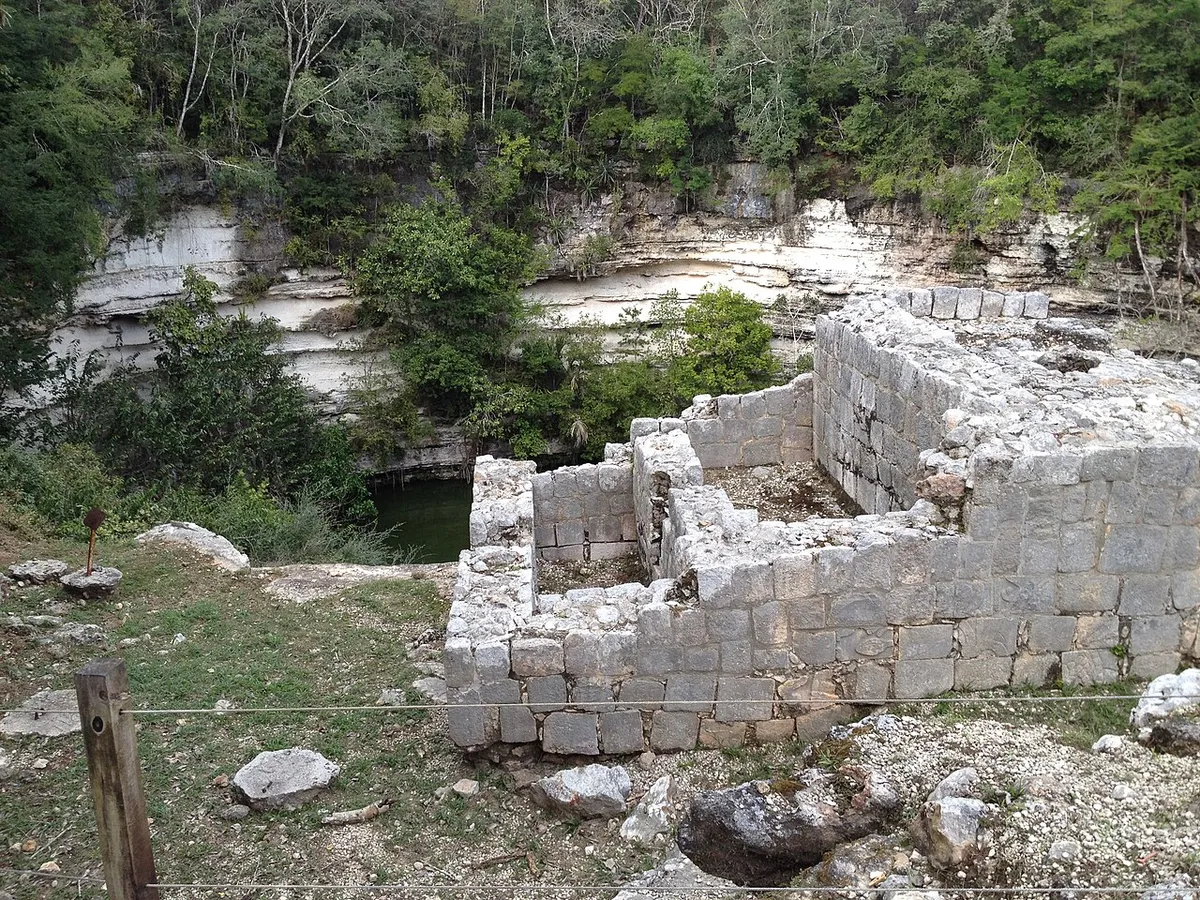
The Sacred Cenote from the platform edge - the stop the vendors' gauntlet precedes. Photo: Wikimedia Commons (CC BY 2.0).
The Thirty-Minute Primer (So Guideless Does Not Mean Clueless)
A self-guided visit only needs a thin layer of history to transform from 'big rocks, hot day' into a legible city. This is the layer - read it on the bus and you arrive knowing what you are looking at.
Five facts that carry the whole site
One: Chichén Itzá was a Maya city whose fluorescence ran roughly 600-1200 AD, with strong central-Mexican (Toltec) influence in its later art - that is why the colonnades feel unlike Palenque or Tikal. Two: El Castillo is a calendar: four stairways of 91 steps plus the platform make 365, and the serpent shadow at the equinoxes is architecture, not accident. Three: the Great Ball Court was ritual, not sport - the stone rings you cannot miss sat 8-9 metres up, and the game's meanings were cosmic. Four: the Sacred Cenote was a pilgrimage well - offerings and human sacrifices went in, dredged a century ago. Five: everything you see is limestone core, long stripped of its painted plaster - the buildings were red, blue and ochre when alive. With those five, the route reads itself.
If you want narration after all
Gate guides remain hireable on the day (MXN $800-1,800 per group) and audio options cover the same ground cheaper - the three-way comparison holds. Nothing about buying a bare ticket closes any door, and the cheapest upgrade of all is the walk back through the buildings table at the end of the visit, when the morning's stones have names.
Photography on an Independent Day
Going alone is the photographic advantage: no group timetable means you photograph at your own light. The practicalities: drones are prohibited; professional cameras may attract a small fee at the gate while phones never do; tripods are impractical in the crowds anyway. The light calendar is simple - 8:00-9:30 side-lights El Castillo from the north (the stair-and-serpent face), the colonnades photograph best mid-morning once sun fills them, and the 15:00-16:00 return light flatters the Osario and Caracol outliers.
Editing note for the honest gallery: the site's lawns are clipped and grey-green at midday; the warm hours are worth planning around rather than fixing in post.
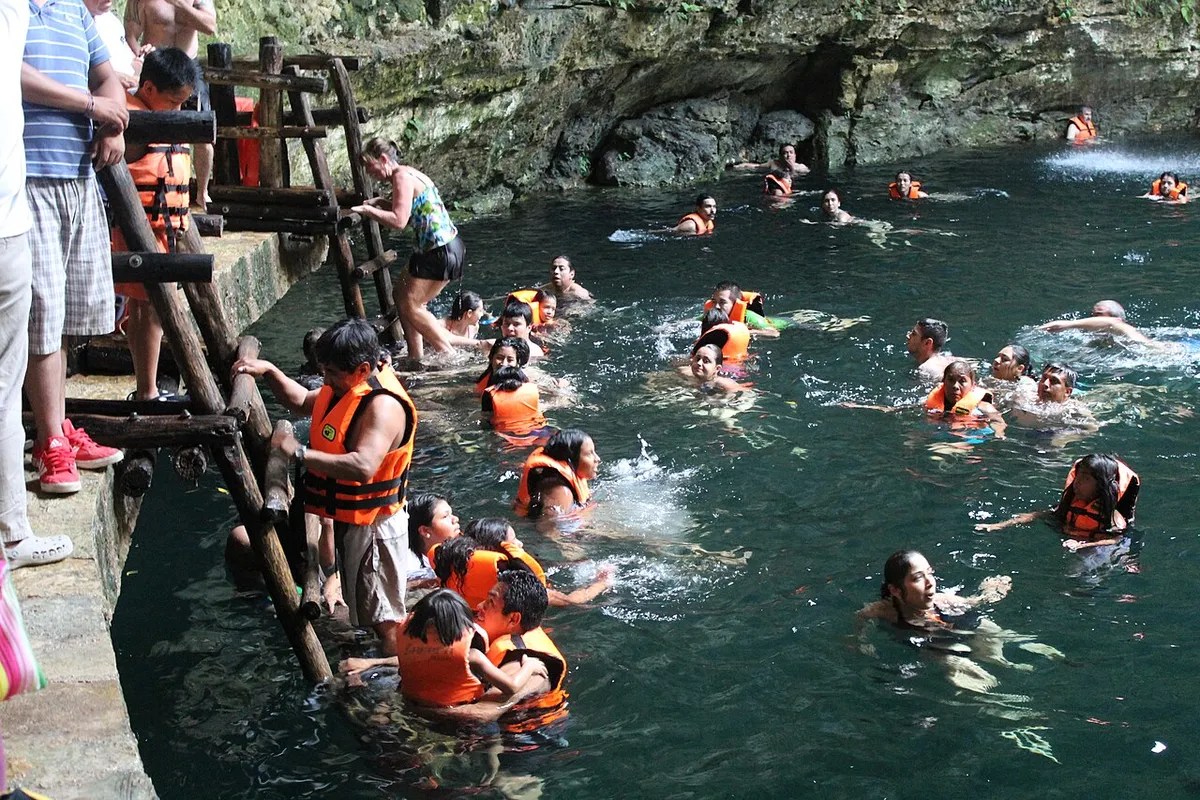
The afternoon swim at Ik Kil - the DIY day's traditional closing argument. Photo: Wikimedia Commons (CC BY 2.0).
Six Buildings, One Sentence Each
The route above names the stops; this is what each one is, compressed for the phone-in-hand reader standing in front of it.
| Building | What you are looking at |
|---|---|
| El Castillo (Temple of Kukulcán) | A calendar in stone: 365 steps by design, feathered-serpent geometry, climbing banned since 2008 |
| Great Ball Court | The largest Mesoamerican ballcourt - ritual theatre with 8-metre stone rings, not a sport stadium |
| Temple of the Warriors | A warrior-theme pyramid fronted by the Group of a Thousand Columns' forest of pillars |
| Sacred Cenote | The 60-metre sinkhole well of pilgrimage and sacrifice - viewing platform only |
| El Caracol | The observatory: window alignments tracked Venus; the round tower has no twin at the site |
| Osario and the Church | The older, quieter southern group - burial structures that show the city before its Toltec-era rebuild |
How to use this table
Skim it in the queue, then let the route order do the sequencing. If a building grabs you, the gate guides are still there to be hired an hour into the visit - the DIY plan and the guided one mix freely, which is the quiet advantage of not buying a package in the first place.
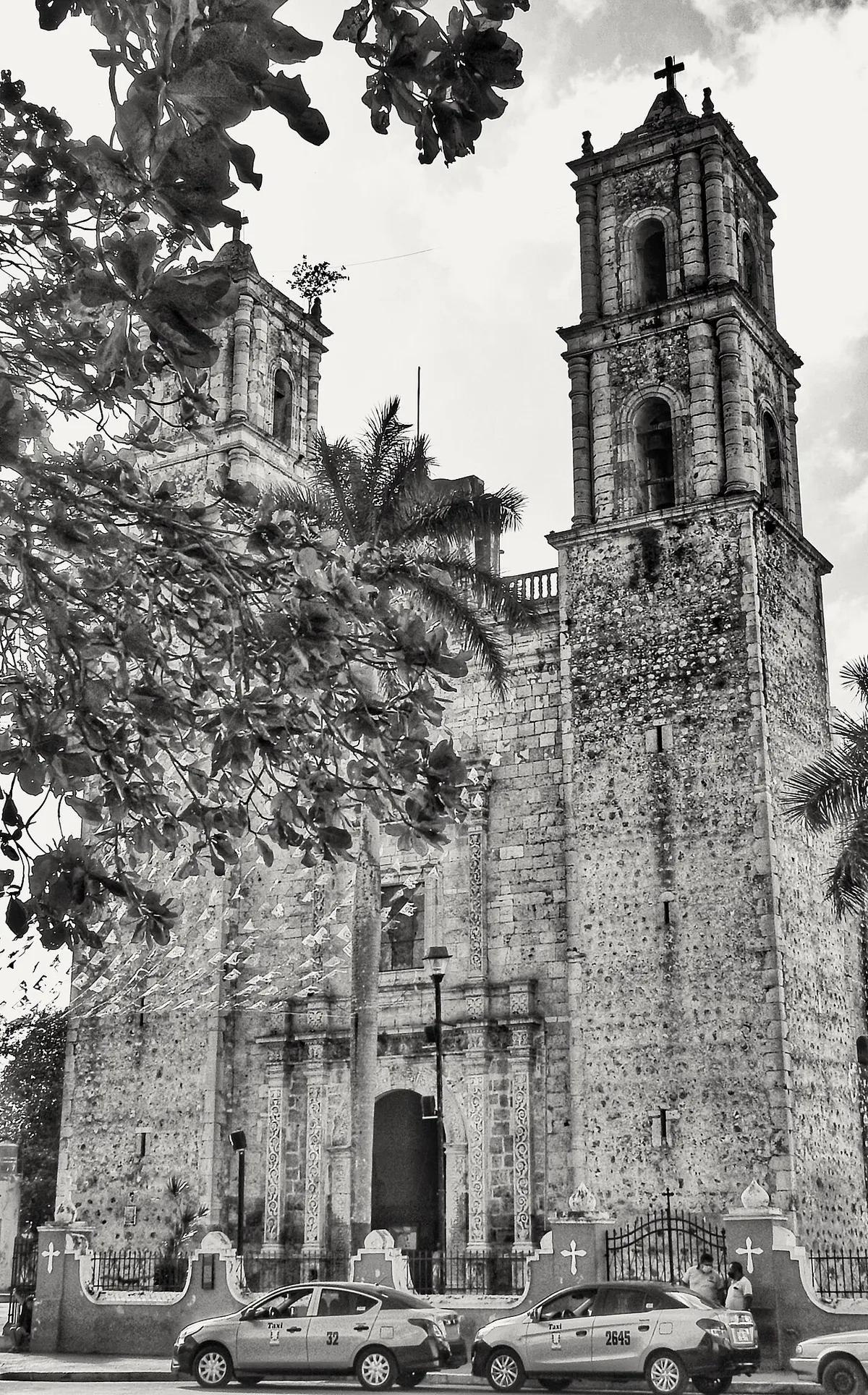
Valladolid after the ruins - the DIY day's natural closing chapter. Photo: Wikimedia Commons (CC BY 2.0).
Troubleshooting the Independent Day
Going alone means fixing problems yourself, so here are the four that actually happen, with fixes. The bus is late or full: colectivos from Valladolid run every 15-20 minutes and cost a fraction - re-route through Valladolid rather than waiting for the next ADO. The voucher will not scan: every platform's app carries the QR offline; screenshot it the night before and the entrance staff have a fallback (manual code entry) that works. The heat wins: the north side of El Castillo and the Thousand Columns' colonnade are the shade arcs - take ten minutes there, drink, and continue; the site has no water fountains, so carry more than feels reasonable. The afternoon storm arrives: shelter by the exit-side restaurants or move the cenote plan early - the site drains fast and rarely closes; waiting it out thirty minutes usually beats abandoning the visit.
Going Without a Tour: Questions
Can you go to Chichen Itza by yourself?
Yes - independent entry is completely normal. One entry ticket covers the zone, transport runs by ADO bus, colectivo or rental car (the routes), and guides are optional at the gate. The DIY cost sheet above runs the numbers against a tour.
Are you allowed to walk up Chichen Itza?
No - El Castillo has been closed to climbing since 2008, and the rule covers every pyramid at the site; everything is viewed from ground level. Ek Balam, 45 minutes north, still allows climbing its main structure if the itch needs scratching (see it here).
How much time do you need at Chichen Itza without a tour?
Two to three hours covers the core loop at an unhurried pace - the walking route times it out stop by stop. Add the outlier groups (El Caracol, the Osario) and you are at half a day; the site closes at 17:00 with last entry 16:00.
Is it worth hiring a guide at Chichen Itza?
For MXN $800-1,800 per group, a certified gate guide earns it if you want the history layer and will ask questions - sharing with another family halves the cost. Guideless with 30 minutes of reading covers the essentials; the three options compared rank them honestly.
How much does it cost to enter Chichen Itza on your own?
The same as anyone: $697 MXN at the gate or $79 online for the all-taxes Tiqets or GYG tickets. No tour markup, no guide fee - the DIY day's only mandatory cost beyond transport and entry is parking (about $120 MXN) if you drive.
Can I take photos and fly a drone at Chichen Itza?
Photos freely - phones are never charged, and only professional-looking cameras may attract a small fee. Drones are prohibited outright. The photography section maps the light hour by hour for the self-guided day.
Is visiting Chichen Itza without a guide boring?
Not with half an hour of reading first - the primer above carries the five facts that make the buildings legible. If the visit feels thin anyway, guides remain hireable at the gate mid-morning; going independent forecloses nothing.
What if the bus is late or my ticket will not scan?
Both fix themselves: colectivos via Valladolid run every few minutes as the bus fallback, and the platforms' apps carry the QR offline for a manual code entry at the gate. The troubleshooting list covers the four failures that actually happen.
Can I leave Chichen Itza and come back the same day?
No - the ticket is single-entry: once you exit, it is spent, so plan the day's purchases (water top-ups, souvenirs) before walking out. That is true whatever channel you bought through, the ticket terms included - the one-fence rule is the site's, not the platforms'.
Do I need to book the cenote swim in advance too?
No - Ik Kil, Zaci and the smaller cenotes sell admission at the door (MXN $150-300); only the ruins ticket rewards advance buying. If you want a lock on the plan, the DIY cost sheet shows the cenote as the day's optional line, purchasable on arrival.